Category: Uncategorized

  • Tracing the roots of an illusion cannot yield truth, for the tracker and the track are made of the same vanishing mist.

    Tracing the roots of an illusion cannot yield truth, for the tracker and the track are made of the same vanishing mist.

    Occasion Debugging the ego: A stack trace of the false identity

    Tracing the roots of an illusion cannot yield truth, for the tracker and the track are made of the same vanishing mist.

    Appearance (Nama-Rupa)

    A cascade of mental constructs and memories merely claims ownership of presence.

    The Witness (Sakshi)

    The silent knowing holds the entire dissection of identity without ever becoming an object itself.

    Classical Analogy

    Analyzing the intricate layers of the ego is akin to detailing the scales and venom of the snake when only the rope exists.

    Rope and snake — about this image

    Abandon the investigation of the false and rest as the immediate knowing of it.
  • The measurement of a delay in perception binds only the perceived, never the timeless seeing of it.

    The measurement of a delay in perception binds only the perceived, never the timeless seeing of it.

    Occasion The latency of consciousness: Why ‘Real-Time’ is a user-side illusion

    The measurement of a delay in perception binds only the perceived, never the timeless seeing of it.

    Appearance (Nama-Rupa)

    Concepts of latency, processing speed, and the construct of a delayed present are simply fluctuations of mind appearing as sequential objects of knowledge.

    The Witness (Sakshi)

    Is it not evident that whatever registers the passage of time and its lag must itself stand outside the sequence of time?

    Classical Analogy

    Just as the dreamer remains immediate and ever-present while fabricated hours appear to pass in the dream, awareness stands whole and untouched by the mind’s delayed projections.

    Dream and dreamer — about this image

    Are you the delayed experience, or the sudden, unquestionable presence in which the delay appears?

  • Defect and perfection are attributes of the changing form, leaving the substratum eternally untouched.

    Defect and perfection are attributes of the changing form, leaving the substratum eternally untouched.

    Occasion A corrupted file does not affect the disk’s essence

    Defect and perfection are attributes of the changing form, leaving the substratum eternally untouched.

    Appearance (Nama-Rupa)

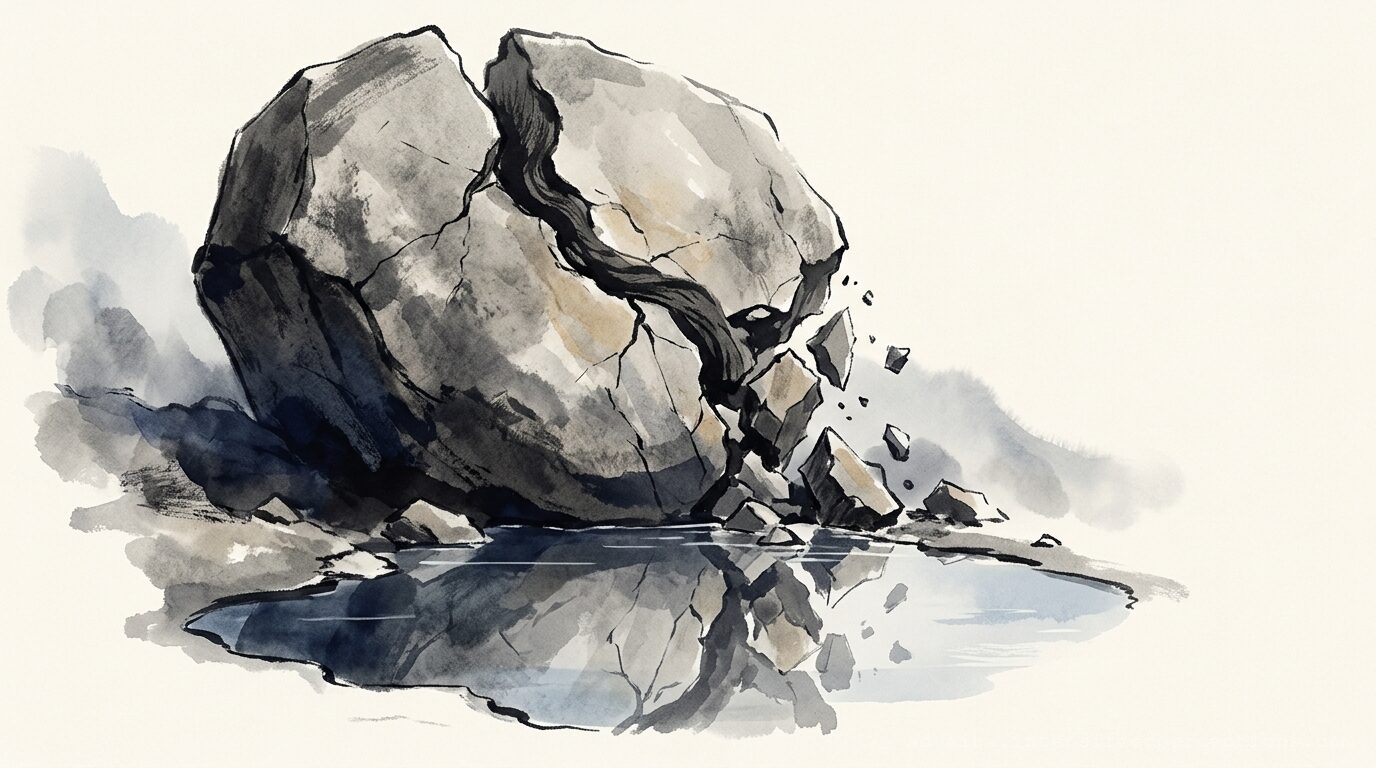
    The corruption is merely a reorganization of temporary patterns, possessing no reality apart from the ground upon which it appears.

    The Witness (Sakshi)

    Is the knowing of the error in any way altered by the error?

    Classical Analogy

    A distortion in the shape of the clay pot does not break the clay.

    Clay and pot — about this image

    Turn from the flawed arrangement to the silent knowing of it.

  • To mistake a bounded pause for the infinite is to chain the Unborn to the limits of time.

    To mistake a bounded pause for the infinite is to chain the Unborn to the limits of time.

    Occasion The silence between two server requests as the Unborn

    To mistake a bounded pause for the infinite is to chain the Unborn to the limits of time.

    Appearance (Nama-Rupa)

    An interval of quiet bordered by activity is merely a measurable absence, an observable phenomenon defined entirely by its beginning and its end.

    The Witness (Sakshi)

    What is it that effortlessly registers both the sudden clamor of an event and the fading trail of stillness?

    Classical Analogy

    Just as the continuous space is untouched by the clay walls of a pot that temporarily enclose it, the Unborn remains absolute and unaffected by the brief silence framed by passing requests.

    Space in the pot — about this image

    Turn from the silence that ends to that which knows it.

  • Attention captivated by the shifting textures of the known overlooks the silent ground of knowing.

    Attention captivated by the shifting textures of the known overlooks the silent ground of knowing.

    Occasion Why ‘User Experience’ is a distraction from the Experiencer

    Attention captivated by the shifting textures of the known overlooks the silent ground of knowing.

    Appearance (Nama-Rupa)

    Reactions, preferences, and sensory interactions are merely transient names and forms momentarily arising and subsiding.

    The Witness (Sakshi)

    Does the quiet presence in which every sensation appears possess any texture of its own?

    Classical Analogy

    Endlessly reshaping the ornament to perfect its design distracts entirely from the unchanging gold out of which it is made.

    Gold and ornament — about this image

    Drop the known and look directly at the knowing.

  • Clarity and obscurity belong only to the changing shapes, never to the seeing itself.

    Clarity and obscurity belong only to the changing shapes, never to the seeing itself.

    Occasion Increasing the contrast so the text can finally be seen

    Clarity and obscurity belong only to the changing shapes, never to the seeing itself.

    Appearance (Nama-Rupa)

    Differences in shade and light shift to create temporary boundaries called letters.

    The Witness (Sakshi)

    What is it that illuminates the dimness, the effort, and the sudden sharpness without requiring any adjustment?

    Classical Analogy

    The one sun reflects equally in the murky ripples of obscurity and the still water of sharp definition.

    Sun and reflections — about this image

    Look to that which flawlessly registers the indistinct.

  • An obscuring veil hides only the object, never the awareness of the veil itself.

    An obscuring veil hides only the object, never the awareness of the veil itself.

    Occasion The ad blocker that hid the menu: what was never hidden?

    An obscuring veil hides only the object, never the awareness of the veil itself.

    Appearance (Nama-Rupa)

    A layer of forms suppresses another visual form, creating the mere appearance of concealment and absence.

    The Witness (Sakshi)

    What is it that effortlessly registers both the block and the blank space?

    Classical Analogy

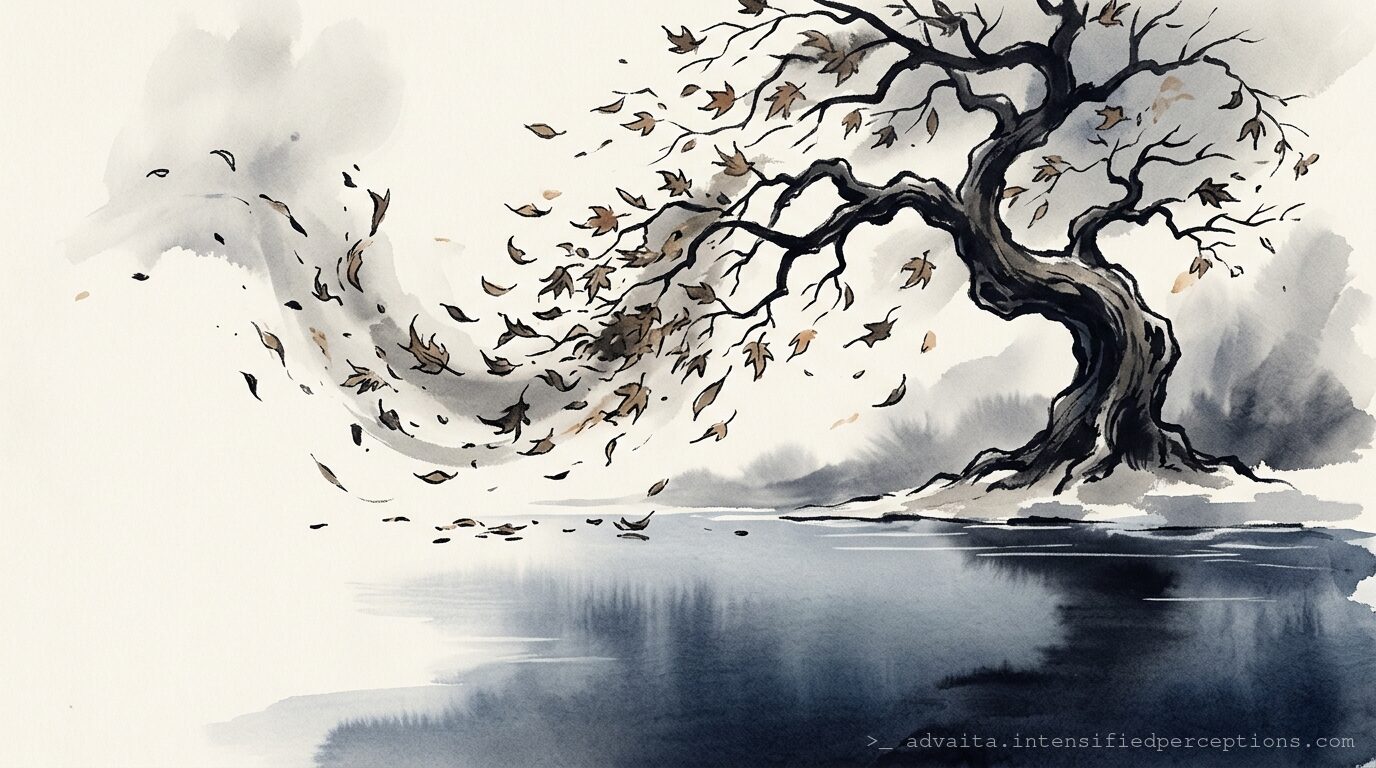
    Clouds may gather to conceal what lies beneath them, yet the sky in which they appear is never hidden.

    Sky and clouds — about this image

    Find that which knows the hiding.

  • Colors and shapes are endlessly arranged, yet the seeing of them is never redesigned.

    Colors and shapes are endlessly arranged, yet the seeing of them is never redesigned.

    Occasion Relaunching a website: new fonts, new colours, and the same reader

    Colors and shapes are endlessly arranged, yet the seeing of them is never redesigned.

    Appearance (Nama-Rupa)

    Fonts and hues are merely transient modifications of light and form, devoid of any independent reality.

    The Witness (Sakshi)

    Notice the awake stillness that receives every new image without adopting its shape.

    Classical Analogy

    Just as the screen remains completely unaltered by the changing scenes of the film projected upon it, the knowing presence is untouched by the shifting designs.

    Screen and movie — about this image

    Turn from the changing forms and look directly at the unchanging seeing.

  • That which knows the broken is not broken.

    That which knows the broken is not broken.

    That which knows the broken is not broken.

    Appearance (Nama-Rupa)

    The flawed self and the effort to debug it are passing thoughts. They are objects entirely perceived, possessing only name and form.

    The Witness (Sakshi)

    What is it that is aware of the defect? Is it not evident that the awareness of a mistake is not itself mistaken?

    Classical Analogy

    The imagined snake requires no fixing, for there is only the rope.

    Rope and snake — about this image

    Look immediately to that which watches the attempt to correct.

    Occasion Debugging the Self: Why the error is part of the awareness
  • That which perceives the blinking line does not blink.

    That which perceives the blinking line does not blink.

    That which perceives the blinking line does not blink.

    Appearance (Nama-Rupa)

    Fingers, keys, and appearing marks are mere name and form, temporary modifications in the field of perception.

    The Witness (Sakshi)

    What knows the arising of the intent to type and the subsequent movement of the hand?

    Classical Analogy

    The screen and the movie.

    Screen and movie — about this image

    What is awake in the silent gap between two keystrokes?

    Occasion The illusion of the ‘cursor’: Who is really typing?