Category: Uncategorized

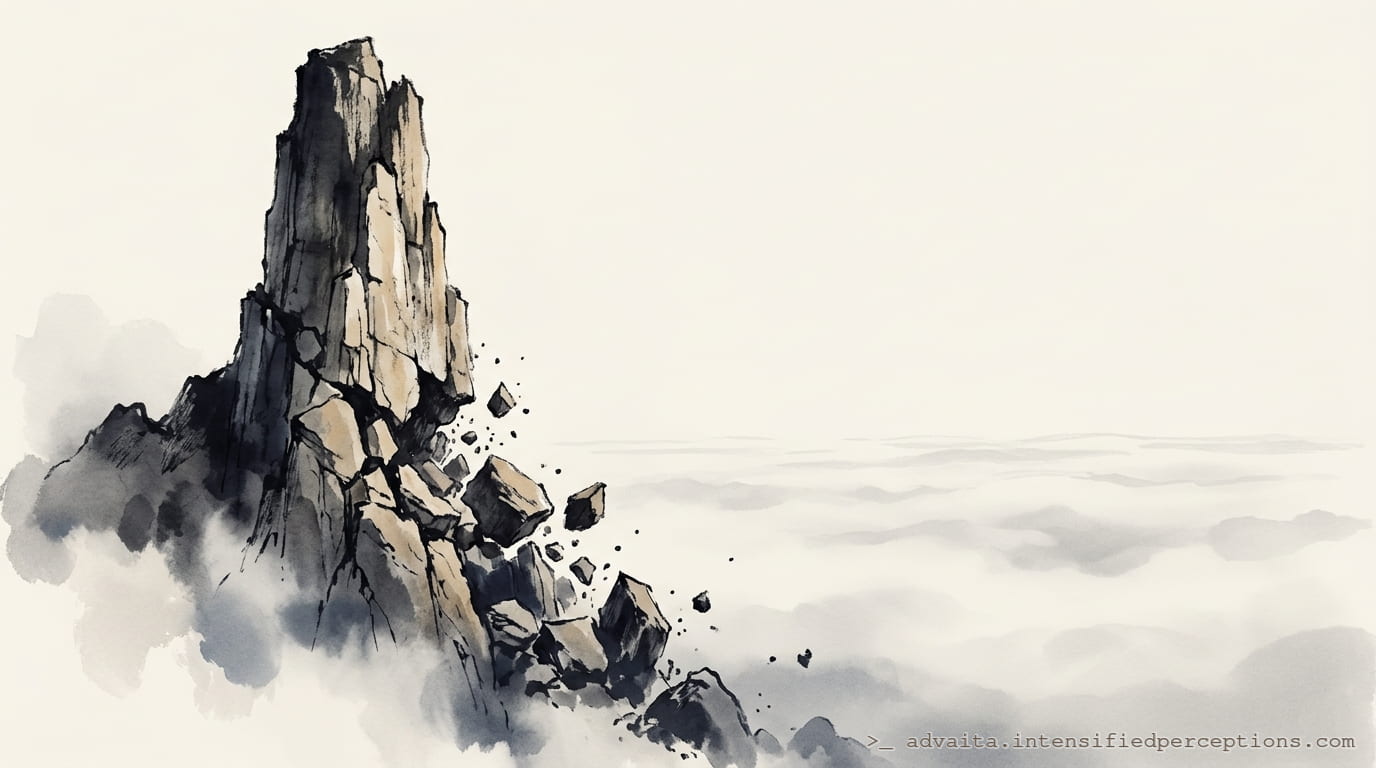
  • Ruin belongs only to what is assembled, leaving the silent knowing of the collapse forever intact.

    Ruin belongs only to what is assembled, leaving the silent knowing of the collapse forever intact.

    Occasion Why the witness does not crash when the system does

    Ruin belongs only to what is assembled, leaving the silent knowing of the collapse forever intact.

    Appearance (Nama-Rupa)

    The system and its failure are merely temporary arrangements of concepts and conditions, rising and falling as measurable events.

    The Witness (Sakshi)

    What registers the cessation of function is not constructed from the parts that break.

    Classical Analogy

    The sudden collapse of a dreamt universe brings no ruin to the dreamer who remains untouched by the imagined catastrophe.

    Dream and dreamer — about this image

    Are you the mechanism that fails, or the unbroken presence in which the failure is recognized?
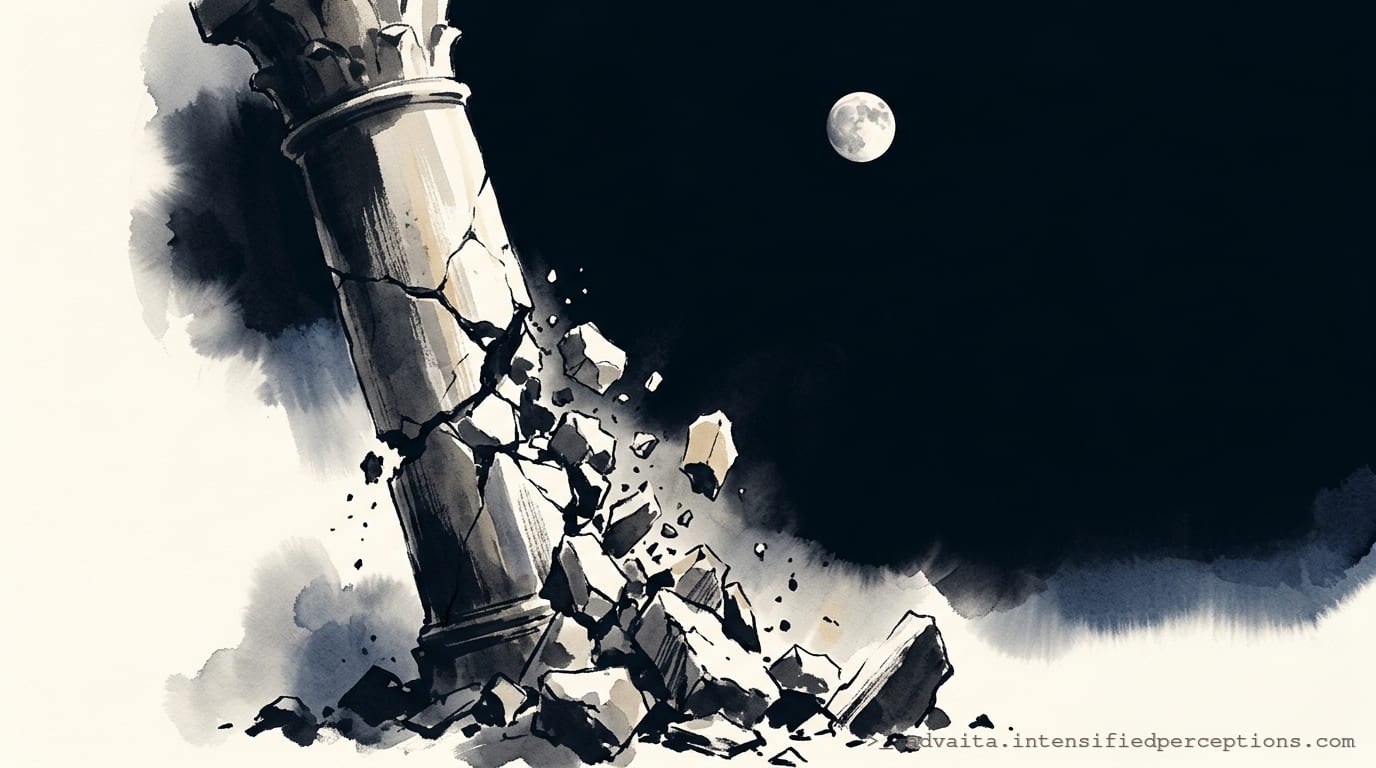
  • When the accumulated weight of the imagined person collapses, the silent ground holding the fragments remains unbroken.

    When the accumulated weight of the imagined person collapses, the silent ground holding the fragments remains unbroken.

    Occasion The stack overflow of the individual self

    When the accumulated weight of the imagined person collapses, the silent ground holding the fragments remains unbroken.

    Appearance (Nama-Rupa)

    The exhaustion of the mind under an unsustainable density of concepts is nothing but a sequence of passing phenomena.

    The Witness (Sakshi)

    Unburdened by volume or capacity, that which is aware registers the failure of the finite without ever being filled or fractured.

    Classical Analogy

    The chaotic collapse of a character projected in the movie neither burdens nor tears the silent screen upon which the scene plays.

    Screen and movie — about this image

    Turn from the shattered pieces of the mind to the untouched stillness that effortlessly watches them fall.

  • Friction requires a second, yet the boundless has no edges to rub against an imagined other.

    Friction requires a second, yet the boundless has no edges to rub against an imagined other.

    Occasion Interrupt Latency: The friction between the Absolute and the I/O

    Friction requires a second, yet the boundless has no edges to rub against an imagined other.

    Appearance (Nama-Rupa)

    Measurements of delay and the boundary of interaction are merely concepts arising within time. The notion of a meeting point between reality and appearance is itself just another passing appearance.

    The Witness (Sakshi)

    Observe the stillness that registers the waiting, the movement, and the perceived gap, itself utterly devoid of time or distance.

    Classical Analogy

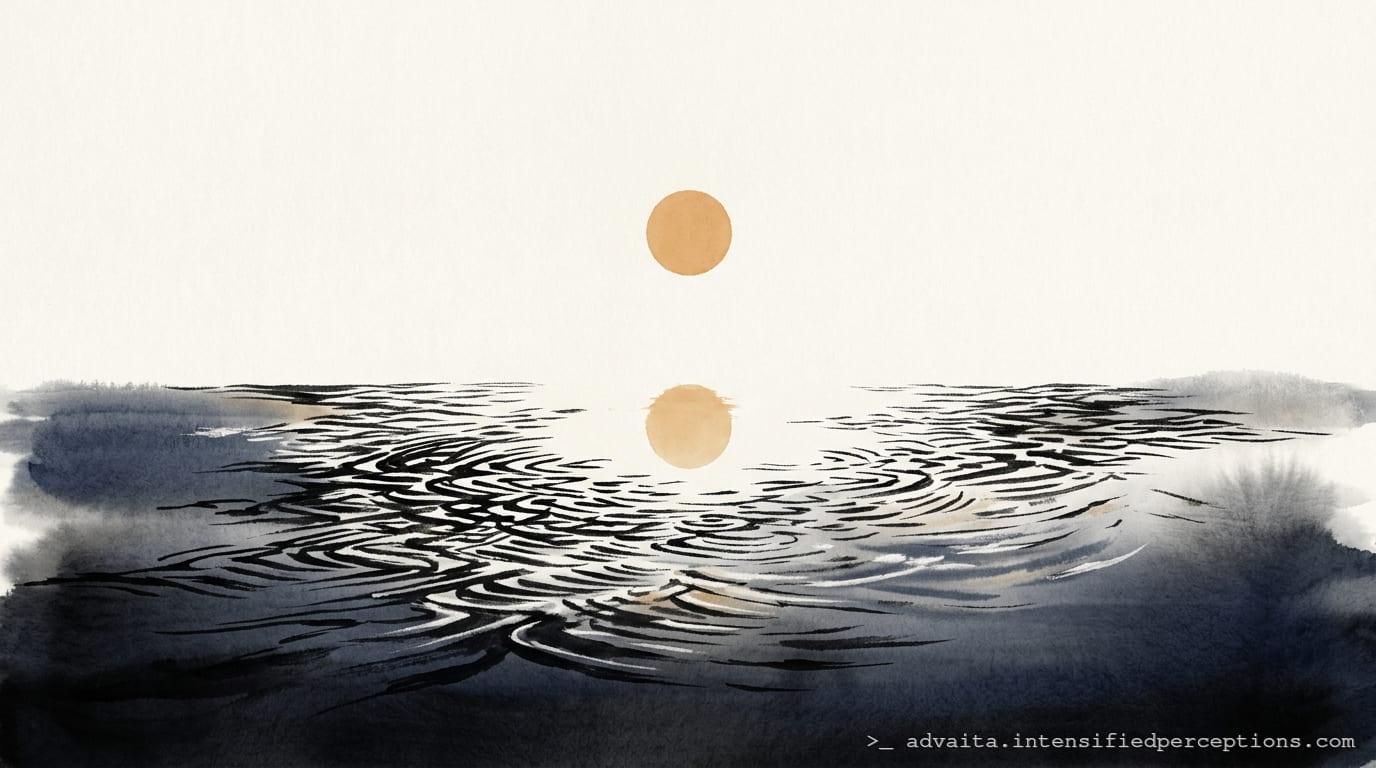
    Just as the sun remains entirely untouched by the trembling delays of its reflections in rippling water, the absolute knows no friction with the transactions playing out within it.

    Sun and reflections — about this image

    Where is the latency in the one who watches the delay?

  • Distance and delay are born the moment form is named, yet the undivided ground remains uncrossed.

    Distance and delay are born the moment form is named, yet the undivided ground remains uncrossed.

    Occasion Interrupt Latency: The friction between the Absolute and the I/O

    Distance and delay are born the moment form is named, yet the undivided ground remains uncrossed.

    Appearance (Nama-Rupa)

    Interrupts, latency, and boundaries are merely fluctuations of time, operating entirely within the realm of shifting shapes.

    The Witness (Sakshi)

    That which is aware of the waiting is not itself subject to the interval.

    Classical Analogy

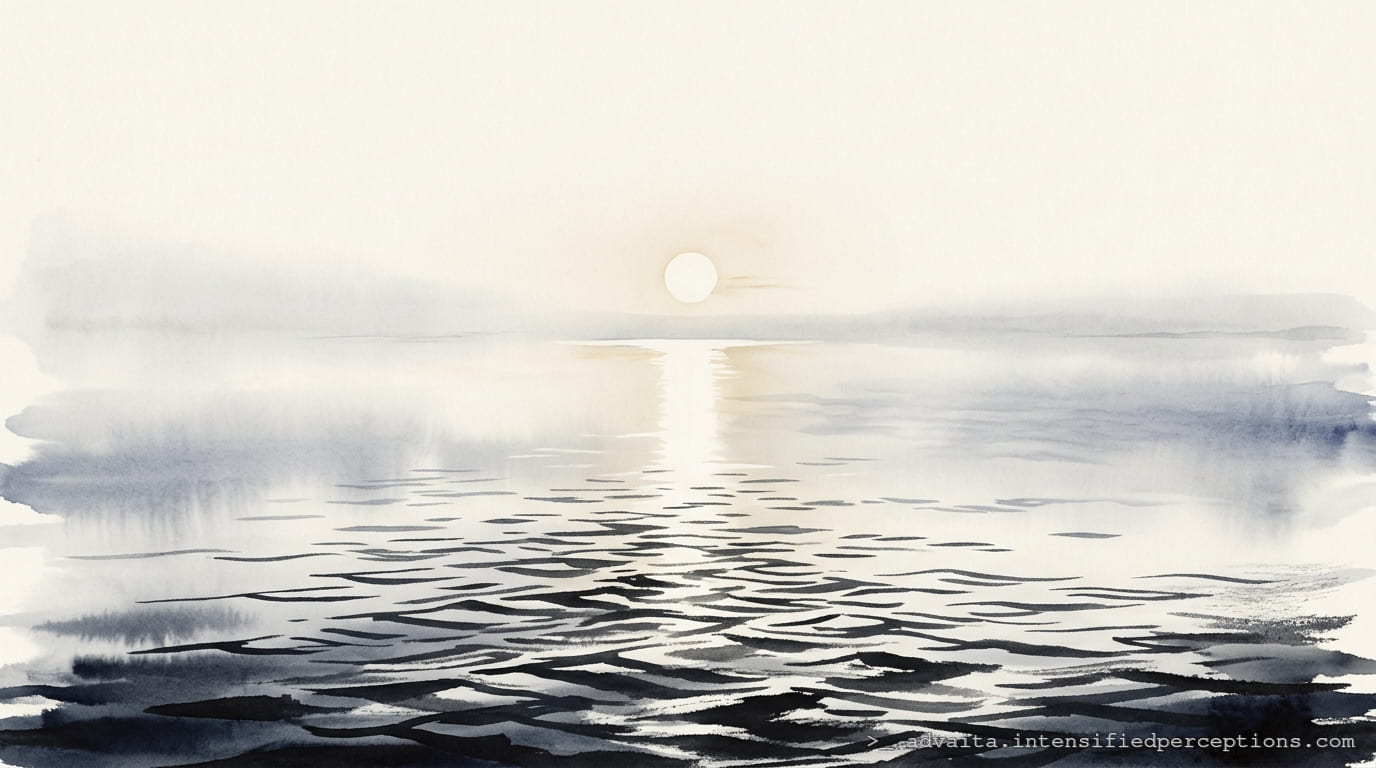
    The one sun appears to waver and delay across the rippling water, yet the unbroken light experiences no friction with the surface.

    Sun and reflections — about this image

    What knows the pause?

  • Every cycle of accumulation and erasure is but a ripple of concept, powerless to soil or cleanse the knowing ground.

    Every cycle of accumulation and erasure is but a ripple of concept, powerless to soil or cleanse the knowing ground.

    Occasion Garbage Collection: The eternal return of the unobserved process

    Every cycle of accumulation and erasure is but a ripple of concept, powerless to soil or cleanse the knowing ground.

    Appearance (Nama-Rupa)

    The gathering of residues and their subsequent removal are fleeting movements of name and form, claiming reality only through the passage of imagined time.

    The Witness (Sakshi)

    Prior to the labeling of what is kept and what is discarded, there is only a silent registering that requires no maintenance.

    Classical Analogy

    The melting down of discarded ornaments to forge new ones is an endless shifting of shapes that neither burdens nor purifies the unchanging gold.

    Gold and ornament — about this image

    Look to that which is aware of the clearing; can it ever be gathered or swept away?

  • What is named an empty core is merely the boundless resisting the confinement of a concept.

    What is named an empty core is merely the boundless resisting the confinement of a concept.

    Occasion The Kernel of Consciousness: Why the Root Account is always empty

    What is named an empty core is merely the boundless resisting the confinement of a concept.

    Appearance (Nama-Rupa)

    Concepts of a kernel or a root account are only hierarchical thoughts attempting to structure the unconditioned.

    The Witness (Sakshi)

    Turn to that which observes the absence of form without itself possessing any coordinates.

    Classical Analogy

    Just as the space inside a pot is neither confined by the clay nor fundamentally separate from the space outside, this imagined root is simply the unbroken Witness appearing localized by the intellect.

    Space in the pot — about this image

    Where does the knower of this emptiness end?

  • Measurements of delay and immediacy bind only the shifting objects of thought, never the motionless ground in which they arise.

    Measurements of delay and immediacy bind only the shifting objects of thought, never the motionless ground in which they arise.

    Occasion Latency in Awareness: Why ‘Real-Time’ is the fundamental delusion of the mind

    Measurements of delay and immediacy bind only the shifting objects of thought, never the motionless ground in which they arise.

    Appearance (Nama-Rupa)

    Latency and sequence are merely names given to the mind’s ordering of passing forms.

    The Witness (Sakshi)

    Look to what registers the concept of time without entering into its flow.

    Classical Analogy

    The vast sky is never delayed by the speed of the clouds passing through it.

    Sky and clouds — about this image

    Are you the sequence of passing moments, or the stillness in which they are known?

  • A collapse belongs only to that which is constructed, while that which witnesses the ruin was never assembled.

    A collapse belongs only to that which is constructed, while that which witnesses the ruin was never assembled.

    Occasion Buffer Overflows of Desire: The inevitable crash of the ego-process

    A collapse belongs only to that which is constructed, while that which witnesses the ruin was never assembled.

    Appearance (Nama-Rupa)

    The gathering of craving and the shattering of an assumed identity are merely fluctuations of the mind, rising and falling as transient name and form.

    The Witness (Sakshi)

    That which perceives the swelling of lack and the breaking of the doer does not overflow, nor does it ever shatter.

    Classical Analogy

    The surging of desire and the breaking of the ego are but waves swelling and crashing upon the surface, never altering the fathomless stillness of the ocean itself.

    Ocean and waves — about this image

    When the entire mechanism fails, what stands perfectly silent to know the silence?

  • To fashion an administrator for the infinite is to mistake the very movement of thought for the silent ground that watches it.

    To fashion an administrator for the infinite is to mistake the very movement of thought for the silent ground that watches it.

    Occasion The Root Access of Being: Why the Seeker is the System Administrator of the Self

    To fashion an administrator for the infinite is to mistake the very movement of thought for the silent ground that watches it.

    Appearance (Nama-Rupa)

    Titles of mastery, hierarchies of access, and the one who seeks them are nothing but conceptual forms shimmering in the intellect.

    The Witness (Sakshi)

    Where is the observer before the idea of control arises?

    Classical Analogy

    Just as the clear crystal only seems to adopt the red of a nearby flower, the unconditioned Self merely appears to take on the role of an administrator when proximate to the shifting mind.

    Crystal and red flower — about this image

    Look prior to the one demanding access.

  • The quiet that follows an ending is not a newly created void, but the eternal background stripped of its temporary noise.

    The quiet that follows an ending is not a newly created void, but the eternal background stripped of its temporary noise.

    Occasion The silence of the terminal: What persists when the process terminates

    The quiet that follows an ending is not a newly created void, but the eternal background stripped of its temporary noise.

    Appearance (Nama-Rupa)

    The initiation, duration, and termination of any sequence are merely transient fluctuations of name and form, entirely bound by time.

    The Witness (Sakshi)

    Observe that which effortlessly holds both the active running of the event and the stark stillness of its absence.

    Classical Analogy

    Just as the screen remains completely unaltered whether a chaotic film is playing or the projector is turned off, the knowing presence is untouched by the starting or stopping of any process.

    Screen and movie — about this image

    Are you the mechanism that winds down, or the silent space that watches it stop?